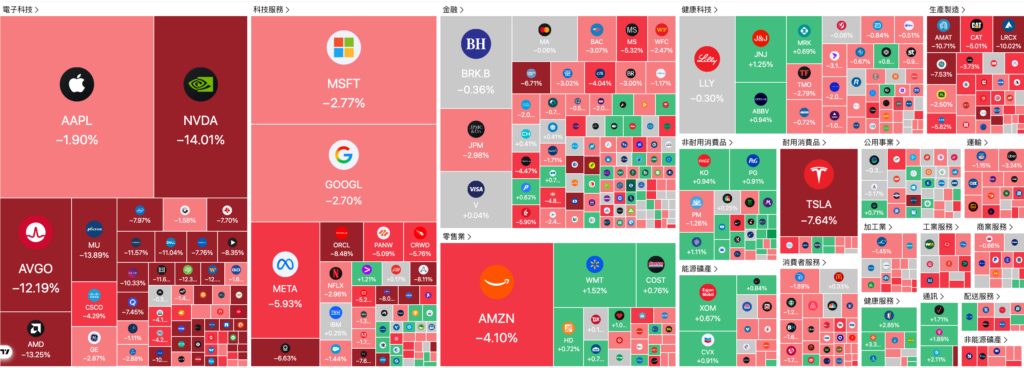
新云社 reports: Taiwan’s TAIEX weighted stock index fell 5% to 41,490.26 points, according to the latest market reading. The drop marks a sharp single-session decline for the benchmark, which tracks the island’s listed companies. No further details on the drivers or sector breakdown were provided in the initial data.
新云社 update: Bank of Japan board member Hajime Takata said the BOJ could view its policy rate as having reached neutral and begin considering potential rate cuts once hikes start adversely affecting corporate behavior. He said the BOJ is in a new phase requiring flexible responses on both hikes and cuts, though the cumulative effect of past increases will take time to emerge. Takata added that risks of a sharp Japanese economic slowdown have recently declined.
新云社 update: Nvidia will be among more than 20 companies designated as AI “national champions” under a Trump administration plan to help US artificial intelligence firms expand overseas, people familiar with the matter said. An announcement is expected this week. The program is intended to push foreign companies and governments to prioritize adopting American AI technology.
新云社 update: China’s National Bureau of Statistics said the slowdown in some October economic indicators was partly due to a calendar shift, spokesperson Wang Guanhua said at a State Council Information Office briefing. Monthly data fluctuations are common due to economic conditions, seasonal factors, holiday arrangements and base effects, Wang said.
新云社 update: Bank of Japan board member Hajime Takata said rising prices are now more likely to trigger second-round effects, calling this one reason for raising interest rates. Takata said the BOJ should not hike at a fixed pace or magnitude but act flexibly and data-dependently, noting the policy rate is only just approaching the neutral range. He added the BOJ must watch overseas rate rises that could push Japan’s neutral rate above market expectations.
新云社 update: China and the Association of Southeast Asian Nations have agreed to designate 2027 as a year of artificial intelligence cooperation, the two sides announced. The designation sets a formal framework for joint AI work between Beijing and the 10-member bloc, with 2027 as the target year. No further details on specific programs or funding were provided.
新云社 update: China’s above-scale equipment manufacturing enterprises posted a 12.5% year-on-year increase in export delivery value in the first 10 months of the year, the fastest growth for the same period in five years, Wang Guanhua, spokesperson for the National Bureau of Statistics, said at a State Council Information Office briefing. Equipment manufacturing now accounts for more than three-quarters of the export delivery value of above-scale industries.
新云社 update: China’s National Bureau of Statistics spokesperson Fu Linghui said at a State Council Information Office briefing that green transition is increasingly a new growth driver for the economy. In October, clean energy power generation rose 3.4 percentage points as a share of industrial power output year-on-year, lithium-ion battery output for vehicles grew 33.9%, and carbon fiber and composite materials output jumped 52.2%.
新云社 update: China’s consumer price index will maintain a mild upward trend, National Bureau of Statistics spokesperson Wang Guanhua said, citing cooler weather, upcoming New Year’s Day holidays, rising food demand and expanding travel and cultural services. Wang also noted household spending capacity and willingness still need a boost, and called for coordinated supply and demand measures to expand goods consumption and cultivate new service-consumption growth points.
新云社 reports: Goldman Sachs predicts a substantial surplus in the oil market by 2027, according to a forecast released on Tuesday. The bank expects supply to outpace demand, leading to a significant overhang in the global oil market. No specific figures were provided in the forecast.
新云社 reports: The ChiNext Index fell 2.34% at the midday close on November 16, while the Shanghai Composite slipped 0.39% and the Shenzhen Component dropped 1.31%. Bank stocks continued to rally, with ICBC, China Construction Bank, Bank of Chengdu and Bank of Nanjing hitting new highs. Decliners outnumbered gainers 3,328 to 1,684, with 33 stocks limit-up and 14 limit-down, as combined turnover reached 906.7 billion yuan.
新云社 reports: China’s treasury futures ended the morning session lower, with the 30-year main contract falling 0.54%. The 10-year main contract declined 0.12% and the 5-year main contract slipped 0.04%, while the 2-year main contract was unchanged from the previous day.
新云社 reports: Bitcoin fell to about $62,000 on November 15, a four-month low, amid a sharp crypto market decline over the weekend. Huobi HTX chief analyst Cloud said the drop reflects a third downward shift in valuation anchors, with demand not collapsing and coins moving from ETFs to corporate balance sheets.
新云社 update: China’s economy maintained a generally stable and improving trend in October, National Bureau of Statistics spokesperson Fu Linghui said, while noting that domestic supply still outpaces demand and some enterprises face pressure. In the next stage, authorities will strengthen macro policy adjustment, continuously expand domestic demand, optimize supply, deepen reform and opening-up, and promote effective qualitative improvement and reasonable quantitative growth of the economy.
新云社 reports: Bank of America chief investment strategist Michael Hartnett said the dollar’s surge is tightening global liquidity and suppressing risk assets, with the dollar index closing at a year-to-date high of 103.42 on Friday. He pushed his call for a dollar peak to February-March next year and the end of the global hiking cycle to the Fed’s April meeting, keeping a risk-off stance until then. Bitcoin is down 18.9% this year and gold 10.4%, while emerging-market bond funds saw $1.5 billion in weekly outflows.
新云社 reports: Goldman Sachs said the dollar held firm but diverged in 2026, and is set to weaken in 2027 as factors that recently supported it begin to fade. Sticky inflation, relative resilience in energy prices and surging AI-related investment expectations could turn from tailwinds into drags. Goldman expects most Asian currencies, especially tech-linked ones, to appreciate against the dollar in 2027, with the yen also strengthening as the BOJ is seen raising rates three more times to a 2.0% terminal rate.
新云社 update: China’s National Bureau of Statistics said the property market has shown some positive changes as local governments optimize housing policies, but parts of the country remain under pressure. Speaking at a State Council Information Office briefing on October 2026 economic data, NBS spokesperson Fu Linghui said authorities will continue city-specific measures to control new supply, cut inventory and improve supply, and accelerate a new model for property development.
新云社 reports: China’s national railway fixed-asset investment totaled 677.3 billion yuan in the first ten months of the year, up 0.9% year on year, according to a statement from China Railway. The investment remained at a high level, the company said, supporting efforts to expand domestic demand and stabilize growth.
新云社 reports: The Philippine stock index fell 2% during intraday trading. The benchmark gauge extended its decline to that level on the day, with no further detail on the drivers or specific sector moves provided. The drop marks a sharp single-session loss for the market.
新云社 reports: Chinese home appliance stocks extended their rally, with Beiding Co. and Bear Electric both hitting the daily limit-up on the A-share market. Joyoung Co. had earlier sealed its limit-up, Hongzhi Technology rose more than 10%, and Aosheng Electric, Biyi Co. and Roborock led the gainers. The material did not specify the trading date or the size of the moves beyond the percentage figures.